
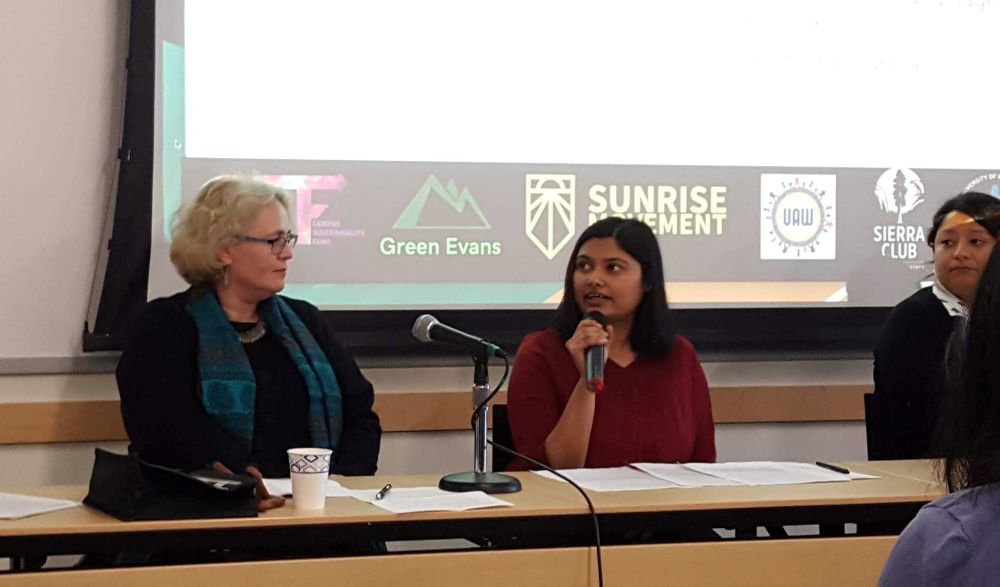
I helped lead the campaign to win a Seattle Green New Deal (GND) in 2019, a groundbreaking legislation that brought community together with union and climate leaders as part of a national movement. I helped craft the Council legislation that established a new Oversight Board, which included allocating seats for community, labor and climate representatives. I was appointed by City Council afterwards and I served on the board from 2021-2025
Why is the Oversight Board Important? The Oversight Board was created to help City officials figure out how policy and public investment can have immediate benefit for workers and communities hit hard by climate change. The Board serves a critical role in centering frontline community voices in Seattle’s goal to greatly reduce emissions by 2030, in ways that also tackle racial, social, and economic inequities.
We do this by 1) telling the Mayor and Council which policies and budget priorities are most strategic for the GND goals, 2) advising City departments on planning and implementation of City climate programs, and 3) coordinating efforts between City staff who work on climate investments, and between related advisory groups.
Serving on the board gave me an amazing opportunity to work directly with community and labor leaders who were on the Board, help drive City budgetary and policy decisions that impact our communities first and most, and model “co-governance” which centers frontline communities in the policymaking process from the very beginning.

Every board will be different, based on who is at the table and the values they bring, but I hope the lessons I learned can be helpful to anyone serving on any board currently or in the future. Below are some of those lessons:
Constant Communication. City budget decisions and policy move fast, while community input is often slow and deliberate. For that reason, we had to stay in constant dialogue with both City officials and our community stakeholders to move priorities forward – both in meetings and out of meetings.
Transparency & Information Access. Board members who represent their communities rely heavily on timely access to information from the City, such as economic forecasts and budget information. As such, we constantly requested information and insights from city staff, not to bog them down, but to help us be effective.
Community Representation. Board members come from a diverse array of communities and hold multiple identities. It is critical that everyone brings their own lived experience as well as their communities’ priorities into the Board’s policy work. Members need to have a pulse on their communities’ issue areas so they can bring information to the rest of the Board that is direct and based on lived experience.
Legacy Stewardship. For community, boards are critical in holding elected officials accountable for their promise of inclusive governance – a role that only we can ensure works. In the case of the Green New Deal Oversight Board, Council sincerely created it to help them be more effective, informed, and responsive to the communities most harmed by climate and environmental policies. It is important to recognize the hard-fought history behind the board’s creation and our duty to remain active and ambitious, and it is up to future generations of board members to carry that torch.

As an outgoing member and co-visionary of the Green New Deal and Environmental Justice-Climate Justice movement, I urge community leaders and future board members to build a strong, united front across community, labor, and climate. Stand in solidarity and always center the voices of the communities most impacted over generations.