Looking back with a full heart and the next chapter of Sage

I am writing to share some personal news regarding the next stage of my journey. On April 10th, I will step down as Executive Director of Puget Sound Sage and Sage Leaders. Leading this organization over the past five years has been an incredible honor. I’m deeply proud of what we have built together; an organization rooted in community, guided by shared values, and clear in its purpose.


Chrissy speaking during a press conference on defending the Seattle Equitable Development Initiative at City Hall, June 2024

Sage’s strength has never rested on any single person. It lives in the collective leadership, sustained relationships, and community trust built over two decades. I feel immense pride reflecting on what we’ve accomplished together:

  • Building grassroots power in the Chinatown-International District, through years of deep community organizing to ensure our neighborhood remains a home for working class and immigrant communities for the #Next100Years.
  • Securing $13 million in funding for the King County Equitable Development Initiative by building a strong coalition of community organizations advocating for sustained funding that supports anti-displacement development projects in years to come.
  • Organizing 250 community members through our first Neighborhood ICE-Free Zone training, canvassing 20 neighborhoods across King County and connecting with more than 500 neighbors to build organizing infrastructure that is durable and consistent.
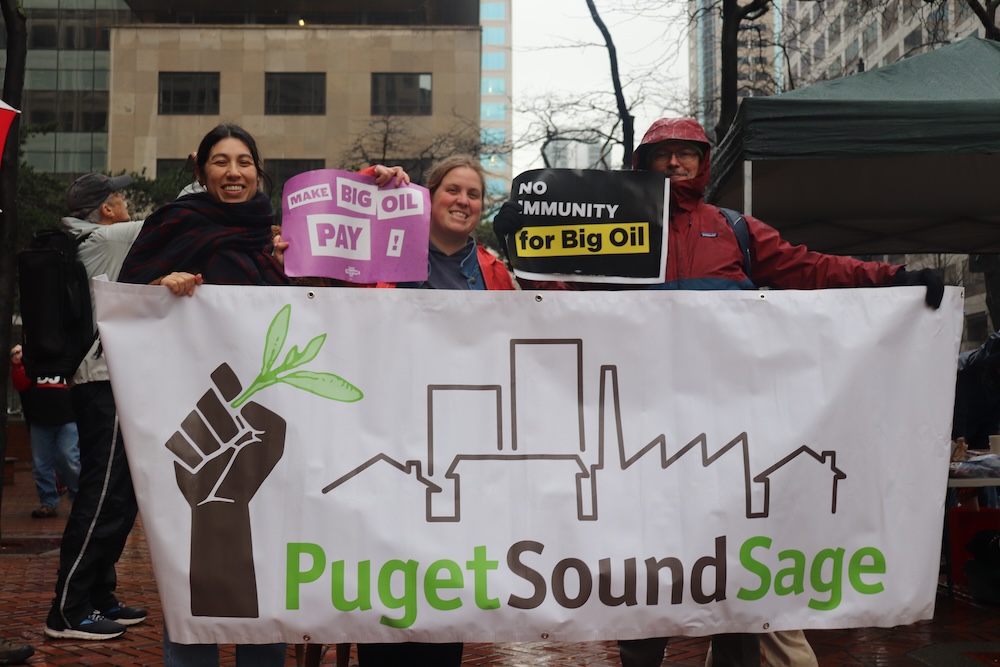
  • Launching a statewide Make Polluters Pay campaign to require the biggest fossil fuel polluters to pay their fair share for the climate damages in Washington State.

Sage staff at the LELI kickoff, June 2024

  • Training over 170 emerging leaders through the Community Leadership Institute, expanding the program to Clark County in 2022 and Snohomish County in 2026, and celebrating 10 years as one of the most successful boards and commissions placement programs for leaders of color in the state.
  • Building statewide leadership infrastructure through Sage Leaders, training more than 300 civic and political leaders and launching the Local Elected Leadership Institute in 2024, supporting first-time elected leaders of color.

(From left to right) Jill, Chrissy and Philip posing at the Macy's Workers Strike, November 2023

The path to this moment has not been easy. I stepped into this role during a period of major organizational transition and in the midst of a global pandemic. During this time, Sage staff organized a union, and together we negotiated two collective bargaining agreements with Workers for a Just Transition.

These conversations were often challenging, but they helped us clarify who we are and what we value. Together we developed an equitable compensation philosophy centered on living wages and invested deeply in workplace culture, political education, collective leadership, and conflict transformation.

This work helped shape Sage’s new five-year strategic plan that directs how we set priorities informed by and accountable to grassroots power. It also nurtured a staff of passionate and talented people, who are deeply committed to each other and ready to throw down at a moment’s notice.

King County EDI coalition at a King County meeting, October 2024

Leading Sage has also shaped me personally. If I’ve learned anything about leadership, it’s this:

  • Great leaders don’t need all the answers. They ask the right questions and bring the right people together.
  • Leadership means making space for others, where people feel empowered to make decisions and deeply connected to what we are building together.
  • Staying grounded in principles takes time, constant communication, and continually assessing the compromises, challenges, and limitations of the nonprofit sector in movement building.
  • Be brave enough to lead even when the path forward is uncertain

Most importantly, I learned that authenticity matters. As a woman of color in leadership, I carried a lot of pressure to show up in ways that didn’t feel like me. Letting that go—and leading as my full self—was one of the most important lessons of this journey.

Sage Staff at the VCLI kickoff ceremony in Clark County, Sept. 2023

As for what’s next, I’ll be just around the corner, literally. I will be joining the Wing Luke Museum as their next Executive Director. I feel incredibly fortunate that my path will continue to intersect with Sage’s work in coalition and partnership just a few blocks away in the Chinatown-International District.

There is much more to say than any letter can hold. Instead, we hope you’ll join us in celebration.

Please join us for a Community Celebration on Friday, April 3rd at the CID Community Center! Expect music, arts & crafts, goodbye toasts, maybe a few tears, and of course delicious food from Bananas Grill.

“Workers for a Just Transition is immensely grateful to Chrissy for her work at Sage. Her wisdom, leadership, and partnership have cultivated a sustainable workplace where we are all proud of the work we do. We all wish you well, Chrissy, and we look forward to our collaborations in the community!” Philip Pantaleo, Workers for a Just Transition Union

“We are deeply grateful for Chrissy’s leadership over the past five years and the care, vision, and commitment she has brought to Sage. This organization has always been built on strong relationships, and we look forward to continuing our partnership with Chrissy. At the same time, we feel confident in the strength of our staff and the broader network that sustains this work as Sage enters this next chapter. We look forward to sharing more about the path ahead.” Tiffany Mendoza, Board President of Sage Leaders

Selfie of Chrissy, JM, Rachtha, Aretha and baby Kaiya at the Sage office, Summer 2025

As I close this chapter, I maintain the unshakeable belief that collective power creates transformative change. Thank you for walking alongside Sage—and alongside me—over the past five years.

Onward, together,
Chrissy 💕

Creating ICE‑Free neighborhoods through deep organizing

Since 2022, Puget Sound Sage has been organizing Seattle’s Chinatown-International District (CID) to ensure the historic neighborhood remains home for working class and immigrant communities for the #Next100years. Over the last several years we have held political teach-ins, public walking tours, movie nights, residential meetings, community assemblies and visioning workshops with elders, local businesses, youth, and families all over the neighborhood. Our elders even led the organizing during public comment hearings with Sound Transit last summer, urging officials to approve the North-South CID station location which will ultimately create opportunities for the CID to build more affordable housing, community gathering places and green spaces.

Today our neighborhood – and our city – faces an ongoing threat.

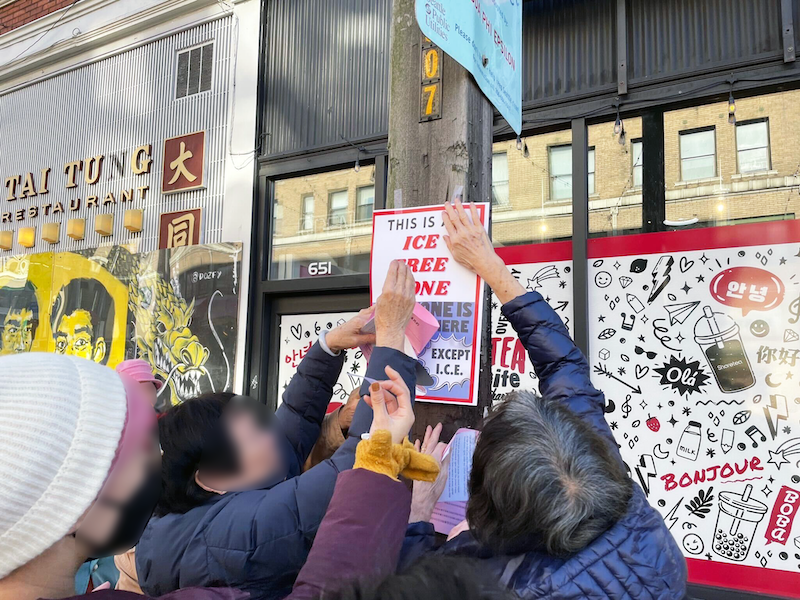
Already our region is experiencing increasing attacks from immigration enforcement agents, and community groups have been mobilizing to respond to ICE sightings and detentions. With Seattle preparing to host the World Cup this summer, we know FIFA will come with a substantial increase in federal presence and surveillance in the CID where the stadiums are right next to. This news has permeated a sense of danger and anxiety for many of our community members, and as an organization that is deeply invested in the safety of our neighbors, we developed an ICE-Free Zone Toolkit containing non-cooperation pledges for residents, local businesses and workers as well as posters our neighbors can display on their windows telling ICE agents that they are not welcome here.

Sage's Organizing Director JM Wong speaks at the ICE Free Zone training on MLK Day
Sage’s Organizing Director JM Wong speaks at the ICE Free Zone training on MLK Day

We don’t have to wait for the City or County to enact policy protecting us from ICE, we ourselves can declare our neighborhoods ICE-Free Zones.

We believe community members are the eyes and ears of the neighborhood and the first line of defense against ICE. They are often the first people to respond and are best situated to support their neighbors. We share our toolkit in the hopes that other neighborhoods across the region adapt it to their needs and use it to support organizing in their own communities. Support this important work by making a donation today!

An organized neighborhood is an ICE-Free Zone.

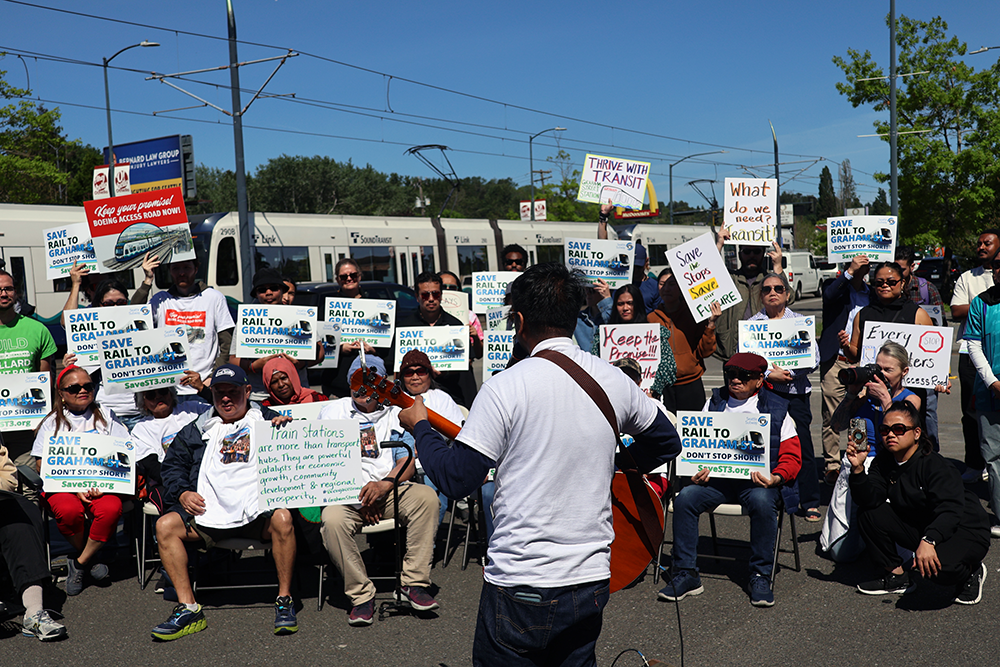
Sage partnered with Whose Streets? Our Streets! to hold a workshop on Creating Neighborhood ICE-Free Zones on the morning of the MLK Day Rally. Over 80 people from across King County packed inside a classroom at Garfield High School where they heard from Sage organizers and elders who shared their own experiences talking to neighbors in the CID about non-cooperation with ICE. Community leaders from the Central District, Tukwila and Kent also spoke about how their communities have responded to ICE presence in their own neighborhoods.

Canvassing 101 Training at Byrd Barr Place 1/25

The following Sunday we invited community members to set up ICE-Free neighborhood groups of their own and held a public Canvassing 101 Training, intending to support even more people across the County to engage deeply with their neighbors. This was the day after Alex Pretti was executed in broad daylight by ICE in Minneapolis. More than 250 people showed up to the training – an unprecedented amount we did not expect, so much so that we ran out of chairs – illustrating the palpable anger and fear we have all been feeling living in this country. Shortly after the training, people went on to canvas in their neighborhoods with the printouts and supplies provided from our toolkit.

Overall, we canvassed over 20 neighborhoods across King County that day, meaningfully connecting with more than 500 neighbors. We talked to small businesses, residents, workers, and families, most of which went on to sign up to be part of their own neighborhood organizing groups.*

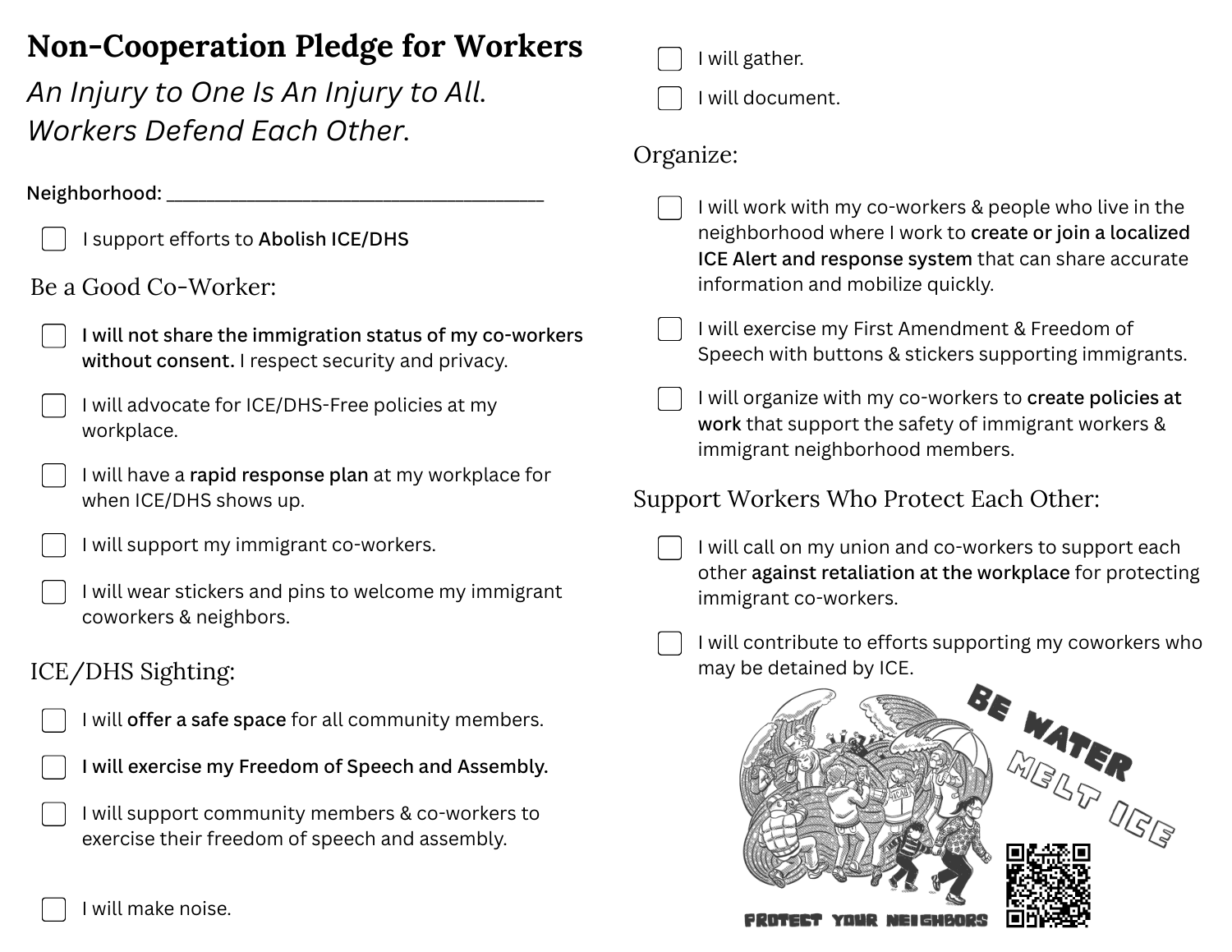
Non-Cooperation Pledge for Workers from our ICE-Free Zone Toolkit

There are many ways to support community members and defend against ICE intrusion and Federal presence.

We recognize the brilliance and courage of many individuals, workers, students, and impacted people who have been coming out of their homes, knocking on doors, organizing and leading the way. We believe that a decentralized strategy is our best defense. It is in this spirit that we offer our own experiences organizing in the Chinatown-International District – a neighborhood with diverse views and lived experiences – to serve as a resource and source of inspiration to facilitate deeper relationship-building among people within their own communities. When ICE comes to our neighborhoods, our people will be organized and equipped with tools and information to protect one another.

Support this critical work by making a donation to Puget Sound Sage today! There are many emergent needs, including translation, community toolkits, printing costs for posters and fliers for small businesses, and more. Your support ensures communities have the tools, training, and resources needed to stand together across our neighborhoods and fight for this future.

Our goal is to continue facilitating these workshops to equip community members across the region with the skills, framework and tools to talk to their neighbors, move perspectives, and create places where all of us – especially our immigrant neighbors – feel welcome and safe. Sign up here to receive alerts, updates, and upcoming training opportunities to organize neighborhood ICE-Free Zones!

*We provide training, tools, and educational resources to support community groups in developing their own independent work. These groups operate autonomously and are not affiliated with, governed by, or directed by our organization. We do not oversee their activities or communications and are not responsible for their decisions, actions, or representations.

Sage’s Senior Policy Manager, Debolina Banerjee, shares some takeaways from serving on Seattle’s Green New Deal Oversight Board

I helped lead the campaign to win a Seattle Green New Deal (GND) in 2019, a groundbreaking legislation that brought community together with union and climate leaders as part of a national movement. I helped craft the Council legislation that established a new Oversight Board, which included allocating seats for community, labor and climate representatives. I was appointed by City Council afterwards and I served on the board from 2021-2025

Why is the Oversight Board Important? The Oversight Board was created to help City officials figure out how policy and public investment can have immediate benefit for workers and communities hit hard by climate change. The Board serves a critical role in centering frontline community voices in Seattle’s goal to greatly reduce emissions by 2030, in ways that also tackle racial, social, and economic inequities.  

We do this by 1) telling the Mayor and Council which policies and budget priorities are most strategic for the GND goals, 2) advising City departments on planning and implementation of City climate programs, and 3) coordinating efforts between City staff who work on climate investments, and between related advisory groups. 

Serving on the board gave me an amazing opportunity to work directly with community and labor leaders who were on the Board, help drive City budgetary and policy decisions that impact our communities first and most, and model “co-governance” which centers frontline communities in the policymaking process from the very beginning.  

Every board will be different, based on who is at the table and the values they bring, but I hope the lessons I learned can be helpful to anyone serving on any board currently or in the future. Below are some of those lessons: 

Constant Communication. City budget decisions and policy move fast, while community input is often slow and deliberate. For that reason, we had to stay in constant dialogue with both City officials and our community stakeholders to move priorities forward – both in meetings and out of meetings. 

Transparency & Information Access. Board members who represent their communities rely heavily on timely access to information from the City, such as economic forecasts and budget information. As such, we constantly requested information and insights from city staff, not to bog them down, but to help us be effective. 

Community Representation. Board members come from a diverse array of communities and hold multiple identities. It is critical that everyone brings their own lived experience as well as their communities’ priorities into the Board’s policy work. Members need to have a pulse on their communities’ issue areas so they can bring information to the rest of the Board that is direct and based on lived experience.  

Legacy Stewardship. For community, boards are critical in holding elected officials accountable for their promise of inclusive governance – a role that only we can ensure works. In the case of the Green New Deal Oversight Board, Council sincerely created it to help them be more effective, informed, and responsive to the communities most harmed by climate and environmental policies. It is important to recognize the hard-fought history behind the board’s creation and our duty to remain active and ambitious, and it is up to future generations of board members to carry that torch. 

As an outgoing member and co-visionary of the Green New Deal and Environmental Justice-Climate Justice movement, I urge community leaders and future board members to build a strong, united front across community, labor, and climate. Stand in solidarity and always center the voices of the communities most impacted over generations. 

Sage’s Statement on ICE Deployment in Seattle

On June 12th, NBC reported that Federal Immigration and Customs Enforcement (ICE) was poised to deploy special tactical units to five blue cities, including Seattle. This comes on the heels of deployment by the Trump Administration of the National Guard and US marines in Los Angeles to support ICE raids, where federal agents tackled children, slammed labor leaders to the ground, and tore families apart.

In addition to this unprecedented use of national troops, ICE has begun using Federal Immigration Court proceedings in Seattle to find and detain immigrants whose cases have been dismissed – often at the request of Federal prosecutors. While immigrant communities have weathered ICE aggression for two decades, these new tactics signal an alarming escalation.

We will not stand by as the Trump Administration attacks ordinary people and the democracy that binds us together.

From King 5 News: DHS allows ICE agents to arrest outside immigration court. A handful of people were detained after their immigration cases were dismissed in the Seattle Immigration Courthouse last week.

Our hearts go out to our immigrant communities who are experiencing fear and loss of freedom across the country, in Los Angeles and here in Seattle. We denounce the actions of the Trump Administration and ICE to militarize immigration policy and violate the human rights of immigrant workers, families, elders and children. We see these acts of persecuting and demonizing immigrants as continued steps in the rise of despotism.

We won’t stand by when local law enforcement gives aid and support to ICE actions. In LA, community and civilian officials are criticizing police and sheriff’s deputies who escalated violence towards ICE protesters, despite LA self-declaring to be a sanctuary city. This past weekend, Tukwila police fired tear gas at protesters who were trying to prevent the detention of community members. Although Tukwila has not declared itself as an official sanctuary city, most of its residents are immigrants.

We do not accept Trump’s pretense for ICE raids in our communities. By coming for immigrants who are “criminals,” Trump wants to create a class of people he is justified in deporting. We all know this is primarily a ruse to rope in as many undocumented people as possible. But we also know that immigrants are more likely to be treated unfairly in our criminal justice system. So-called “criminals” are often members of our community who have done their time and paid their dues, like any U.S. citizen. But unlike U.S. citizens, they are punished again with deportation and a lifetime of family separation. As the Black-led abolitionist and transformative justice movements of the last decade have taught us, no one is disposable. We should not accept that some immigrants are more deserving of deportation than others for political reasons. We believe in healing, not lifetimes of retribution.

From Seattle Times: Tukwila police fire pepper balls on protesters at unusual ICE check-in. ICE and Border Patrol agents grab a protester outside of the Department of Homeland Security Field Office on Saturday, June 14, 2025, in Tukwila.

We are fortunate to live and work in a sanctuary county, or in Seattle, a sanctuary city. But pledges of sanctuary will be tested in the coming days, weeks and months. We call on the city mayors, public prosecutors, county executives and the Governor to fulfill their promises to not aid and abet ICE or military troops enforcing ICE actions. Protecting our immigrant communities involves more than non-support of ICE – it requires proactive strategies.

Actions our elected officials can do proactively, include:

  • Uphold the purpose and commitments of Keep Washington Working and sanctuary governments that have already been made and campaigned on to win their election
  • Not collect and share data with Federal immigration agencies
  • Not attack or criminalize people resisting detention by ICE, nor protesters and supporters aiming to protect noncitizens
  • Not allow publicly owned facilities, such as our ports, jails, and schools to be used for arrest, detention and deportation
  • Use all our local and state due processes to protect immigrants from Federal overreach
  • Take extra precautions in neighborhoods and places where a majority of immigrants work, live, go to school and pray.

We will likely see even more aggression by Trump and ICE against immigrant communities in the coming months. Who, how, and why we push back matters for our human rights and local democracy.

In Solidarity,

The Sage Team


Give a warm welcome (back) to Claudia, who will serve as Interim Executive Director while Chrissy is on maternity leave!

“Hello! My name is Claudia Alexandra Paras. I’m a mixed-race Filipina American immigrant with citizenship privilege. I moved to the U.S. in 1998 with scholarships to attend the University of Redlands in Southern California. After graduating, I moved to Seattle (on a whim to be near water again) and started planting my PNW roots through cultivating deep friendships, learning how to organize in our communities and centering social justice in my work.”

“I worked at Sage from 2012 to 2016, starting as a coalition organizer who supported the workers organizing at SeaTac Airport. I helped create and build the Interfaith Economic Justice Coalition (IEJC) that stood with airport workers in their fights for a living wage, which became the landmark $15 SeaTac ballot initiative in 2013 which had rippling effect on minimum wage fights around the country. I’m very proud of the role Sage played in that campaign and my contribution to organizing a dedicated coalition of interfaith leaders to stand with workers through all their challenges. After this campaign win, my role at Sage changed to Lead Organizer and then later on to Deputy Director.”

“I have over 20 years of experience in immigrant adult education, grass-roots community organizing, campaign and coalition organizing, fundraising, managing government contracts and strategic planning. For the past three years, I’ve been a consultant with a focus on supporting non-profit organizations, unions and government departments to create strategic plans, fundraise and develop leadership. I love what I do – it gives me the chance to work with a lot of people of color leaders and their staff who are value centered, super-skilled and care deeply for working people and their families.”

“Last year, I facilitated the creation of Sage’s new Strategic Plan for 2025-2030, which has felt like completing a large orbit in my professional life, returning to an organization I have always loved and seeing what has changed and grown in my absence. I’m grateful to be part of implementing Sage’s long-term vision in my role as Interim Executive Director for the next 4 months, especially as we continue to navigate the challenges of our current political climate.”

Favorite memory of working at Sage? “Organizing the IEJC contingent for May 1st Rally in 2014 to defend the SeaTac Ballot Initiative. My Mom (also an immigrant) came to that rally and it was a sweet moment for the political and personal.”

Favorite food in the CID? “Szechuan Noodle Bowl – the dumplings!!”

Favorite Movement Quote? “We need dreamers who act, not actors who dream” by Lorena Barros

Lobbying for the Equitable Development Initiative and statewide energy assistance in Olympia

On February 13th, Sage’s Aretha Basu and Eliana Horn along with Yordanos Teferi of Multicultural Community Coalition (MCC) and Chelsea Lee from Eastside for All, traveled to Olympia representing the King County Equitable Development Initiative Coalition to talk with legislators about Sage’s first bill in Olympia, SB 5138 which would change the uses of AIRBNB tax, otherwise known as short term lodging tax, to include equitable development in King County.

Seattle already has the ability to use the AIRBNB tax for equitable development and it is a consistent portion of funding for the Seattle Equitable Development Initiative (EDI). With an EDI starting up in King County, we are fighting to make sure the County has the same ability as the City of Seattle. And great news, the day before arriving in Olympia, our bill passed the Senate because of your support! We spoke with seven legislators about this bill and are looking forward to continuing to move it through the House in the coming month!

Our Senior Climate Policy Manager Debolina Banerjee also joined Front and Centered’s Advocacy Day this past month to lobby for HB 1903, which calls for a statewide energy assistance program. No one should have to choose between energy and their other basic needs. While there are a variety of energy assistance programs out there, according to Washington State Department of Commerce only about one in five low-income households who qualify were being served by such programs as of 2023.

Make sure to follow our partners at Front and Centered to get updates on this important bill!